Legitimate Concerns in Riverside County are Hard to Explain
45,896 more ballots than voters. Liberty Vote machines appear to be adding ghost ballots.

We need to keep a close eye on this one. The community group that did the work in Riverside did what appears to be an outstanding job, while the Registrar of Voters does not even take it seriously. And worse, the Board of Supervisors appears not to understand the issue at all.
Location: Riverside, California. (1,406,690 Registered Voters)
Election: Special election for Proposition 50
Equipment: Liberty Votes (formerly Dominion) voting system
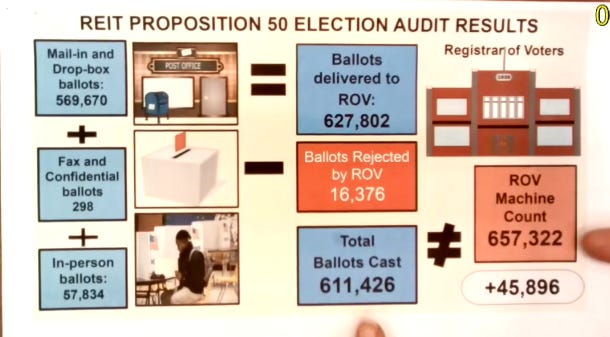
Total ballots cast: Paper records say 611,426 while computer says 657,322.
Net difference: 45,896 more ballots than documented in paper records.
Thus, there are more ballots counted by the Liberty Vote election system than are accounted for by paper records. Ideally, these numbers should match exactly. The ROV seems to not want to look at the paper records at all, and they discount the issue by saying the paper records are unreliable and are subject to human error.
Of course this is political fodder
Sheriff Chad Bianco, candidate for governor, has made a play by confiscating all the ballots from the Riverside ROV. Some say the action is purely political, playing into the same “election denier” narrative. The ROV, however, states that the difference is only 103 ballots and the election system results are correct. If the ROV is not going to investigate, then perhaps they are allowing Bianco to make this play. They could have done their own investigation.
https://www.usatoday.com/story/news/politics/elections/2026/04/03/ballot-seizing-sheriff-chad-bianco-california-riverside/89349378007/

Registar of Voters: Art Tinoco
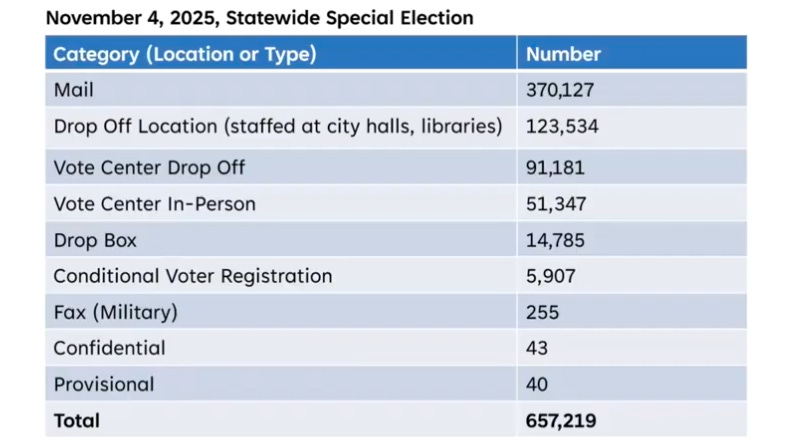
ROV says the following, relying on reporting by Dominion (Liberty Vote) machines.
Community group says:
So what sort of records were reviewed by the community group? They examined the statements from the in-person voting centers, like the one below.
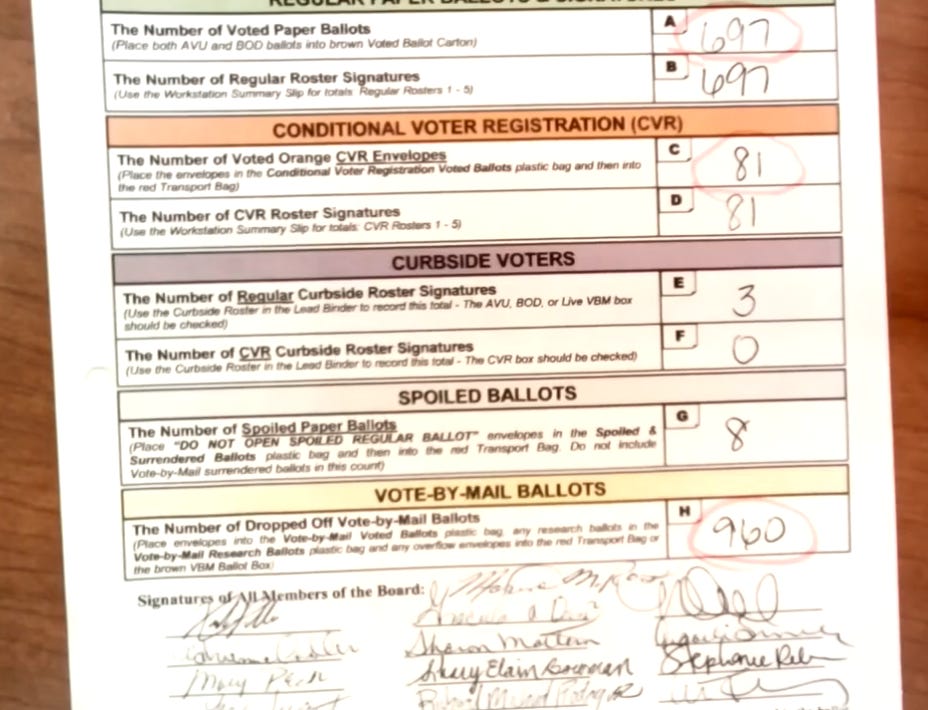
Those numbers are clear and easy to read. The ballots are typically counted and recounted to ensure accuracy. All board members at the voting center must sign the statement and attest to its accuracy.
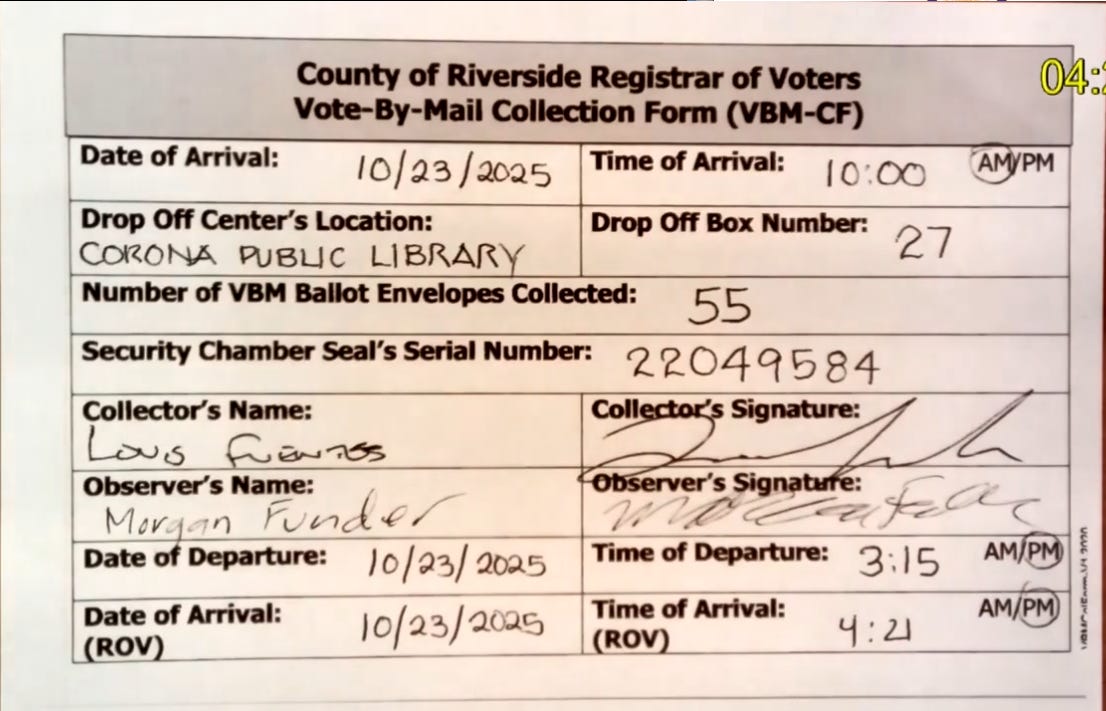
They also obtained all the forms from the drop boxes, like the one below, which are also easy to read. These forms are completed by Registrar of Voters (ROV) staff, whether temporary or permanent, and can be trusted to a significant extent. They are also signed by the collector, Louis Fuentes, and witnessed by observer Morgan Funder. This appears reliable.
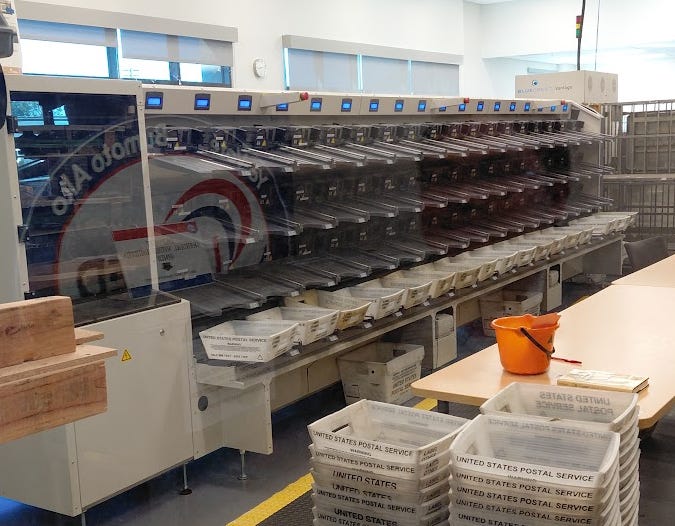
When vote-by-mail ballots are delivered to the office, they are enclosed in envelopes and processed by a BlueCrest ballot processing machine.
Below is a picture of this machine, which can accurately process vote-by-mail envelopes into batches. It captures an image of each envelope, including the QR code that identifies the voter, and matches it to the voter record database. This system helps ensure that no voter can vote twice; if a voter has already voted in person, the ballot is rejected. These machines are highly accurate and are not subject to typical human error.
The community group reviewed this log sheet for VBM ballots received from the USPS.
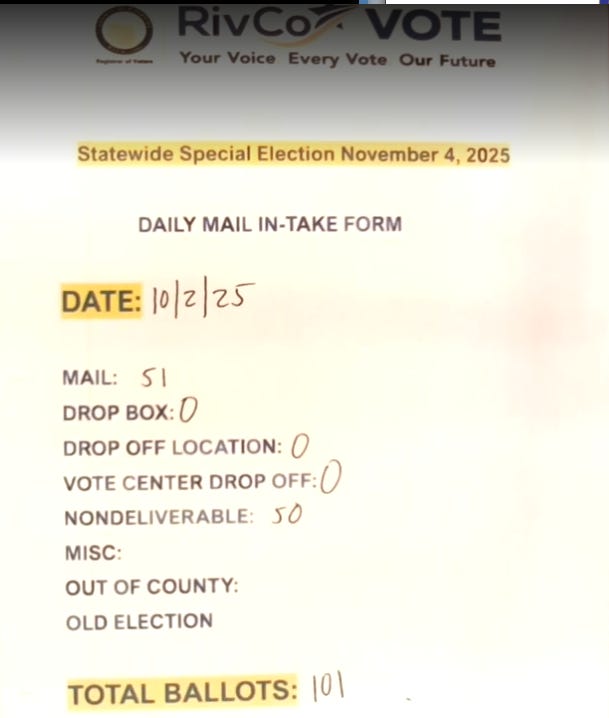
They say the total is the MAIL: line with 51 ballots included. The NONDELIVERABLE ballots are those that were returned without being voted, for example due to the voter having moved.
In some cases, signatures do not match. Therefore, from the raw numbers, the total must be reduced by the number of signature mismatches that are not cured. This yields the total number of “good” ballots.
Please note: we are not counting votes here, only ballots. Some ballots may be invalid for several reasons, and that will only reduce the total number, not increase it.
Board of Supervisors Meeting
You can watch the BOS meeting for Riverside County at the following link. You can skip to approximately 3:30:00 (3.5 hours into the meeting):
https://riversidecountyca.iqm2.com/Citizens/SplitView.aspx?Mode=Video&MeetingID=3355&Format=Agenda
What I found disturbing is that the ROV failed to address the numbers in their own paper records and instead provided only summarized totals. They also discussed other unrelated information about voter registration rolls, which is not directly related to the issue in question.
Community group comment start at about 4:40:00.
4:50:00 Best testimony was from Jim Niederecker
We love show and tell, we have seven of these [boxes], 3,500 pcs of paper . It took 100s of hours to gather all this. I’m going to describe how we did the audit and why we believe it is legitimate.
We did a process audit. In a process audit, the auditor must gather objective evidence to demonstrate that the process meets the requirements.
We collected that evidence, based on 15.1302(d) where ballots cast has to equal votes counted. Cindy and Sharon just did a great job describing these records, all 3500 of them.
All the records we asked for, we got. There were none missing. The ballot counts from all these records were input into excel spreadsheets and tallied. To ensure no mass calculation errors, the spreadsheets were validated. I learned that from medical device history, 35 years.
We also collected ballot counts regarding conditional ballots, ballots received by fax, and confidential. Art said we were missing some of those. No. We’re not missing any of those. All of these represent the ballots that were input into the system.
Art said you’ll need the raw data. Yeah, they’re raw data. That’s what came in. We have physical records of the ballots that showed up. Then, we provided the number of ballots rejected or not counted, such as ballots with mismatched signatures that were not cured.
Art said maybe we made a mistake we did not account for the rejects? The rejects are in there.
And thank you from … that we got that correct. We have rejects from provisionals, conditionals, and all other ballots. That accounted for about 16,000 rejects.
That count was deducted from all the ballots that came in. So now we know the number of ballots that were “good”. So Art made the point that we need to count good ballots? We know what the good ballots are. We have what came in and what was rejected.
The allowable error in this process is one error in 125,000 ballots tabulated. Jeff Nelson said there is no requirement. There is a requirement and that is it.
None of the last four elections even came close to meeting that requirement. Art showed a table that showed percentages? None of those percentages meet the requirement that need to be met. We recongnize that Art did not train this system, he did not program it, and he did not pick it. But he’s got to live with it because that’s what we’ve got. So we need to make it work.
It’s been claimed that these statements are outside the system and are error prone. Cindy and Sharon did a real nice job of explaining that they are reliable. There are three election codes, and the roster audit all point to the fact that these statements are part of the process. The vote center ballot statements and vote by mail collection forms are independently counted by two people.
… This is not difficult. I watched two people count ballots at the Melbourne library, and they had a big stack, a couple of hundred. They checked them twice and then the lead came over and said let’s check it again. So they got counted three times. So this process is not that hard, to count pieces of paper. The USPS form? Everything that comes in has to go through the mail sorter. That mail sorter counts very accurately to get a number and they put it on the page. So if that’s a human error, what other human errors are they making throughout the process. We think that process is very robust, so we think the use of these numbers makes perfect sense. We think they are accurate.
There was a mention that there could be errors on these statements. We made sure that none of those numbers on those statements was part of a math error. That’s not a viable error mode.
The staff says these numbers are no good. But they never interviewed any of the leads, never interviewed any of the people making the counts. They just “Know” these statements are not accurate. They did NO INVESTIGATION.
We know the BlueCrest Sorter knows how to count. They know that these statements are inaccurate, but in the three audits we were able to complete, the ballot counting errors are consistently on the low side resulting in thousands more ballots counted than cast. If I’m going to have random random errors be some up and some down? That’s not the case. Every time we do this, we get more counted than cast. So they are always counting to the low side?? Does not make any sense.
You’ve got 3,000 statements. That’s 3,000 counting activities with 2 pairs of people, and they always made a mistake on the low side. Does it make sense? We don’t think so.
The 2% industry standard that Jeff Nelson mentioned, that 2% industry standard applies. I stood here two weeks ago and said that the Secretary of State said there is NO 2% industry standard. I didn’t bring the email from the Secy of State to give it to you to show that that doesn’t exist. But I’m going to send it to you.
Mr. Tran and our team are going to meet in about 2 weeks or so and we’re going to talk through this accuracy standard. And so we’ll be able to put this to bed.
Jeff said there is no allowable error rate. That’ makes absolutely no sense. You can’t say “Any error is okay”.
…
In closing, the ROV must document their reconciliation process. You all should see the numbers, before you accept it. Art’s numbers are different from my numbers. And I used the report from the EIMS that I was told to use. His numbers are now different. So we need to see a report of where did he get his numbers, so we can try to figure out why we are so far off. (mike cut out).
Court Case
The action by Sheriff Bianco is being reviewed by the California state court to determine whether it is legitimate.
I understand that the next court hearing will be on April 13. I may drive up to Riverside from my home in San Diego to observe.
Regardless of the court case, the ROV should recount the ballots — not a vote recount, just a ballot sheet count. One sheet per ballot. This can be done using a counting scale.
Attempting to count all the ballots without proper planning is difficult in an election with 657,000 ballots. The experience in Maricopa County AZ was that the Cyber Ninjas count was off by approximately 300,000 ballots, determined by using machines that count paper but do not move the paper. In this case, weighing the paper may be a practical method.
The “Bantam-1” machine counts sheets by slightly deforming the corner in front of an optical detector. This method was used in Maricopa. The machines can insert tabs every specified number of ballots and have very high accuracy, although paper can occasionally stick together. I think most people are not aware of this option.
See this video:
In this case, a counting scale is much more cost-effective. The JCE-30K has a 60 lb capacity (1,000 ballots can be easily handled) and is in the $449 price range. Purchasing two of these would make the process faster than using a Bantam-1–type counter. But using both may be a smart move to make damn sure the ballots are counted.
Thus, counting the ballots would take about a week at most. With the scale, it takes only a few seconds to load, allow it to stabilize, and then read the count.
They will likely spend more time in court and discussing this than actually resolving it.
There are two major possible outcomes to the process:
Paper ballots match the Liberty Vote machine count. But then, we still have to figure out where the paper came from, or question the paper records.
Paper ballots match the paper records. This is even worse. It means the paper ballots were scanned twice or loaded twice or that the Dominion/Liberty machines are changing the numbers in the results instead, and in such a way that the election officials will stand by the results.
We must be concerned
Connect the dots. The Dominion voting system was purchased by an unknown group associated with the pollbook company KnowInk (See my substack post “Dominion Voting Systems Secretive Buyout — Liberty Vote is owned by a complex matrix of Delaware shell corporations and LLCs.”) Now, we see that this voting system is dreaming up 45,000 ballots that were not cast.
This will not change the results in the Proposition 50 election, which passed 64.4% to 35.6%, with about a 3,000,000-vote margin of victory. So the 45,000-ballot discrepancy in Riverside will not affect the outcome. Some would argue that this means there is no cause for concern, but I disagree. This discrepancy must be understood.
How could it happen?
There are only a few possibilities:
The paper forms were consistently filled out incorrectly, resulting in an aggregate error of 45,896 ballots. This initially seemed possible, but it is unlikely given that each sheet accounts for only up to about 1,000 ballots.
Some paper records were not included in the community group work. This would exonerate the system and the results, but put into question the fact that all records were supplied.
Ballot count matches paper records. Ballots were scanned twice in the scanning process.
Ballot count matches paper records. Ballots were scanned once but transferred twice to the Election Management System. I have seen this occur in Volusia County FL and Monmouth County NJ but only for Election Systems & Software (ES&S) voting systems.
Ballot count matches paper records. The Liberty Vote (Dominion) system generated “ghost ballots” internally. This would imply a serious systemic issue.
Dominion/Liberty systems could, in theory, influence results across election districts nationally in November.
Election Officials should routinely check their paper records
These paper records are created but not fully reconciled by the ROV, which appears to rely heavily on the Dominion (Liberty) voting system, trusting it over the paper records.
This could indicate a much, much larger issue that we need to resolve prior to November.
I will stop here. As I learn more, I will provide updates. I may attend the hearing on April 13.
April 10 Update: April 13 Hearing Off Calendar
The previously scheduled April 13 hearing in Riverside Superior Court will not take place. The parties jointly requested that the matter be taken off calendar, and the case has been paused at the trial court level.
Current Status of the Case
The case is now before the California Supreme Court (Case No. S295901), which has granted review and assumed control over the proceedings.
The Court has issued an order that:
Halts the Sheriff’s investigation
Requires that all seized ballots be preserved
Directs the parties to propose measures to safeguard the materials, including possible transfer to a neutral custodian
The matter is now in an expedited briefing phase, with key filings due in mid-April. No in-person hearing has been scheduled at this time.
Warrants Unsealed
One other development in the case is that the search warrants used to seize the ballots have now been unsealed. This makes the underlying investigative basis and supporting declarations publicly available for review, including quantitative details about the ballots themselves.
Six-Month Retention
We noted that these ballots are subject to California’s retention requirement for elections with no federal offices, which requires preservation for at least six months rather than the 22-month federal standard. For a November 4, 2025 election, that would place the earliest destruction date at approximately May 4, 2026. However, that timeline is no longer operative. The ballots have been seized under warrant and are now subject to court orders requiring that all seized materials be preserved. As a result, the normal retention schedule has been superseded, and the ballots must be maintained until the court directs otherwise.
Warrant-Based Ballot Estimates
The warrants show that the investigation proceeded in stages, with multiple warrants issued over time. This suggests that the scope of the seizure was incrementally expanded, rather than executed as a single, fixed operation. That pattern is consistent with investigators developing their estimates as additional boxes were examined.
In the most recent warrant, the investigator reports counting ballots in 22 boxes, totaling 12,561 ballots. This yields an average of approximately 571 ballots per box. Applying that average across the full set of 1,086 boxes gives an estimated total of 620,106 ballots.
This estimate can be compared to two reference figures:
Election office reported total: 657,322 ballots
Community group estimate: 611,426 ballots
Using the warrant sample:
The estimate is short of the official total by 37,216 ballots
There are 1,044 boxes remaining beyond the 22-box sample
To match the official total, those remaining boxes would need to average about 606 ballots per box, or roughly 36 more ballots per box than the sampled average
By contrast:
The community group total is 8,680 fewer than the sample-based estimate
This would require the remaining boxes to average slightly lower than the sample, by about 8 ballots per box
Interpretation of the Sample
Based strictly on the warrant sample:
Matching the official total requires a significant upward shift in ballots per box relative to the sample
Matching the community group total requires only a modest downward adjustment
Thus, the sample is more consistent with the community group’s reported total than with the official reported total, assuming the sample is representative.
This remains a preliminary comparison. The key variable is whether the 22-box sample is representative of the remaining 1,044 boxes. But the fact that the sample more likely supports the community group’s assertions should give them more credibility in addressing the question about whether a full count should be performed.
Communication to Riverside Sheriff’s Office
Since it appears they did not read this substack article (What!? They don’t read my substack??!!) and used pure (and time consuming) hand counting rather than machine-assisted counts, I sent the Sheriff’s office a note with a link to his substack to assist in any future counting projects using their web portal. Some argued that they would know very well how to count paper (probably count cash sometimes, but cash counting machines are common and not useful for ballot counting), but it appears they just did a quick sample of 22 boxes and counted by hand.
—Ray
P.S. So sorry that my substack has been neglected for a while as I have been deep in auditing and improving our auditing system, AuditEngine. See more at https://AuditEngine.org. Please stay tuned for more frequent updates!
All posts: https://substack.com/@raylutz/posts
States need to replace the voting machines. It will be more work but role of EAC needs to be replaced at state level while federal government is swimming in corruption and fraud. Idk how but that’s what think tanks are for…
Come join us - we are working on a system to detect and catch ghost voters. We’re tracking the voter rolls.
Would love for you to join us - feel free to contact us at itsuptous@grassrootsspeak.com
They think they’re going fix the midterms in 2026 but not if we can help it…
https://itsuptous.substack.com/p/post-9-i-see-dead-voters-trump-ghost?r=6nql92&utm_medium=ios&shareImageVariant=solid