Election Transparency Progress in Pennsylvania -- baby steps.
Big win for transparency not so big when you read the fine print.

The PA Supreme Court Honey v. Lycoming County Offices of Voter Services decision establishes a clear legal holding: Cast Vote Records (CVRs) are public records under the Pennsylvania Election Code. The Court’s reasoning is direct. CVRs are not the “contents of ballot boxes” and not the “contents of voting machines.” They are reports generated by tabulation systems and therefore fall within the category of “records” subject to public access. That part is huge.
It affirms that the public has a right to access the CVR report that can be used to show that the election results are consistent The Court explicitly ties this to the principle of “trust but verify,” emphasizing that transparency supports confidence in election outcomes.
You can read the whole thing here (it is interesting reading for true election nerds, lol): https://law.justia.com/cases/pennsylvania/supreme-court/2026/79-map-2024.html
What the Court Actually Granted
The ruling is strong on classification but incredibly narrow on access mechanics.
CVRs must be disclosed, but only under the procedures defined in the Election Code. This creates a controlled-access model rather than open distribution.
Key constraints (are you kidding me?):
Access is limited to “qualified electors” of the county
Inspection occurs only during normal business hours
Review must occur in the presence of election officials
Access is subject to “safekeeping” controls by the county
These constraints are outrageous, but the court had to comply with the wording in existing statutes. The Court explicitly states that the Right-to-Know Law (RTKL) does not apply where it conflicts with the Election Code, and therefore cannot be used to obtain CVRs more freely. But time will tell how they end up interpreting this.
Many if not most places around the country are now willing to provide the CVRs, and many states like Georgia, now also say that ballot images are available too. Florida even allows access of paper ballots on-site, but were (until recently) routinely deleted ballot images. We have obtained ballot images from counties in WI, NJ, GA, FL, CA, CO, and TX just to name a few.
Practical Interpretation
The ruling creates a separation between legal transparency and operational transparency.
Legally:
CVRs are public records
The “contents of the ballot box” exemption does not apply
The public has a right to verify tabulation
Operationally:
Counties retain control over access conditions
Data extraction is not guaranteed
Copying vs. viewing remains ambiguous and likely contested
The Court repeatedly refers to “inspection” rather than “distribution.” It suggests that jurisdictions may comply by allowing supervised viewing of CVRs without providing digital copies. That’s frankly ridiculous, because it means you can’t easily handle processing of the data. But I am open to being wrong on this.
Implications for Audit Efforts
We planned to get CVRs and ballot images from major PA counties so we could check on the results of the 2024 general election. You may remember that PA was close, with Trump getting 3,543,308 votes while Harris got 3,423,042, a measly 120,266 vote difference. That’s only 1.7% margin between just those two candidates, which is quite close. So close in fact, that the state decided that they would rather audit the State Treasurer’s contest, with a 426,943 vote difference (6.12%) and then do nothing to check on the Presidential contest. You heard that right. No Checking. So this ruling might actually allow us to either get the CVRs and ballot images, and allow us to perform ballot image audits and check on the result.
[An aside, ballot image audits can only do a consistency check between the images and the CVRs. If there are 45,000 ghost ballots like what we are seeing might be the case in Riverside, CA1, then the result will check and yet be desperately wrong. But the same is true for auditing methods like Risk Limiting Audits, so an audit of the chain of custody of the ballots is still a great idea. We have until the end of August to get these records before they are destroyed after 22 months.]
(I have to admit I have always been skeptical of the Trump win in 2024 to exactly 1.5000% (between Trump and Harris only). That reads like a line in a contract.)
BUT…
They did not rule on the availability of ballot images, and if they restrict the CVR access per what the ruling implies, then it’s not a big win at all.
The unanimous nature of the decision strengthens its authority, but its silence on ballot images leaves a gap.
Strategic Reality
This is a breakthrough in legal footing, not yet a breakthrough in data access.
The Court removed the primary legal barrier by rejecting the “contents of voting machines” argument. That is significant. It aligns Pennsylvania with jurisdictions that treat CVRs as auditable records.
At the same time, the enforcement mechanism remains decentralized. County election offices still control the conditions under which access occurs.
Ballot Box Exemption is silly anyway
So they have a law from 1937 that says that the contents of the ballot box are not accessible to the public via the PA RTKL. But why? Is it because they want to be able to mis-count the ballots, come up with some fabricated number, and then say, “You’ll have to trust us, because of this law from 1937 means you can’t check on the result”?? The secret “Australian” ballot was largely adopted by 1937 in most states, but was not fully adopted nationally until 1950s. So there may have been a lingering concern about looking at the ballots.
Plus, I get that access to actual paper ballots must be restricted because of the danger of modification or destruction. But not really due to privacy concerns. You can’t tell who voted on a random ballot selected, and elections are designed that way.
But once a restriction gets in place, it can be hard to undo it. In Georgia, they had a simple new law passed by the legislature that just said that ballot images were public records. Done. (But of course with later strings attached).
The courts can’t make new laws. They can only interpret what is on the books, so we will need some legislative action.
Bottom Line
The decision establishes that CVRs are public, which is a major development for election transparency. However, access is mediated through restrictive procedures that may limit practical usability. We need to get the data so our software can process it, not just view it.
But we need to at least try at this stage, and if we get blocked, then legal action may be necessary, but again, legislative action would be better to expand access rather than nit pick over meanings of words.
Can you help?
We seem to need people who at least live in PA and are willing to be on a list of electors we are asking data for.
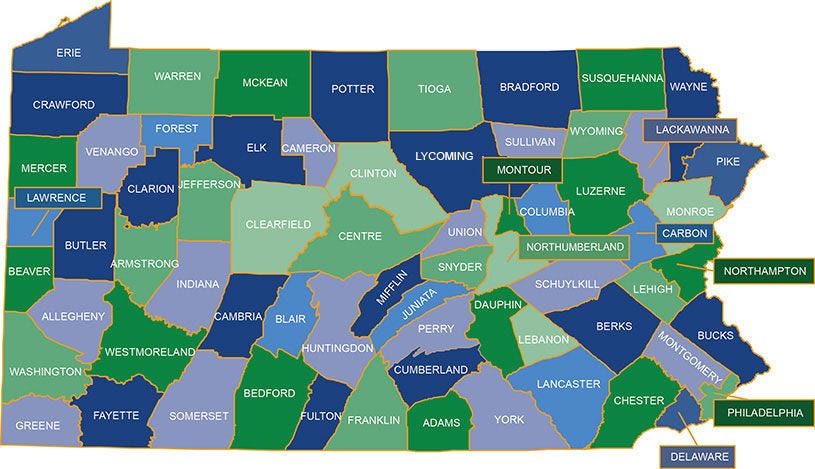
Our primary targets for our audits are the following 18 counties (in order of importance): Philadelphia, Allegheny, Montgomery, Bucks, Delaware, Chester, Lancaster, York, Westmoreland, Berks, Lehigh, Northampton, Luzerne, Erie, Dauphin, Cumberland, Lackawanna, Washington. That accounts for about 75% of the electorate while auditing only the top 25% of the counties in the state. Pareto pretty much holds. And yes, most of these are right around Philly.
If you live in PA and esp. in any of these counties, please contact me so we can add you to our (privately held) list of residents that we will reveal only to the election offices if requested. That’s it. We just need your name and later, perhaps a signed affidavit that you live in PA.
Please contact me by direct message if you can help! Click the button below if so!
— Ray
