Dominion Voting Systems Secretive Buyout
Liberty Vote is owned by a complex matrix of Delaware shell corporations and LLCs.


1. Shhh! Don’t look.
In late 2025, the nation’s largest voting-system vendor, Dominion Voting Systems, was quietly sold and rebranded as Liberty Vote. How patriotic. It must be good, right?
Public headlines framed it as a patriotic “return to American ownership.” But Delaware corporate filings reveal a far more complicated reality: a tangle of shell corporations — Liberty Vote Corp., Liberty Voting LLC, Liberty Vote Holdings Inc., Liberty Vote Intermediate Inc., and Liberty Vote USA Inc. — formed in 2009, 2018, and 2025, each with different registered agents and none disclosing their true owners.
The timing aligns precisely with the acquisition, showing a carefully staged restructuring designed to obscure who actually controls Dominion’s assets. In 2016, its machines served 70 million voters in 1,600 jurisdictions. This is a major voting system vendor, and we must watch and understand!
2. A Partisan Irony
The public face of Liberty Vote is Scott Leiendecker, founder of the Missouri-based poll-book company KNOWiNK and former Republican director of the St. Louis City Board of Elections.
Leiendecker presents himself as a reformer restoring trust in U.S. elections, but his partisan background raises obvious questions. He says he is not MAGA supporter and does not fully support Trump. I say that is probably just cover.
The company most vilified by Trump and his allies after 2020 — Dominion Voting Systems — has now been taken over by a Republican operative from that same political camp.
It is an extraordinary reversal: the movement that once denounced Dominion now effectively controls it.
3. A Pattern of Access Breaches
Public concern about ownership secrecy is sharpened by a series of documented breaches involving Dominion equipment after the 2020 election:
Coffee County, Georgia (2021): Local officials allowed outside operatives linked to attorney Sidney Powell to copy Dominion software and data.
Mesa County, Colorado (2021): Clerk Tina Peters permitted outsiders to image Dominion servers before a state update; Colorado decertified the equipment, and Peters was later convicted. This breach also exposed the fact that Dominion routinely installed the Microsoft SQL System Management Suite (SSMS), essentially a database editor, that could be used to modify the results without any voting-system logging or official tracking. But all this was ignored due to the admission of outsiders without the approval of the Secretary of State.
Antrim County, Michigan (2020): A brief reporting error was used to justify seizing machines for partisan “audits,” though a state investigation confirmed it was human error.
These episodes show that actors aligned with the Trump orbit sought and gained unauthorized access to voting systems, including all source code and disk images. But why struggle to gain access to source code when you can just buy the company?
4. The Corporate Maze
The Liberty Vote structure resembles a private-equity buyout more than a civic technology company.
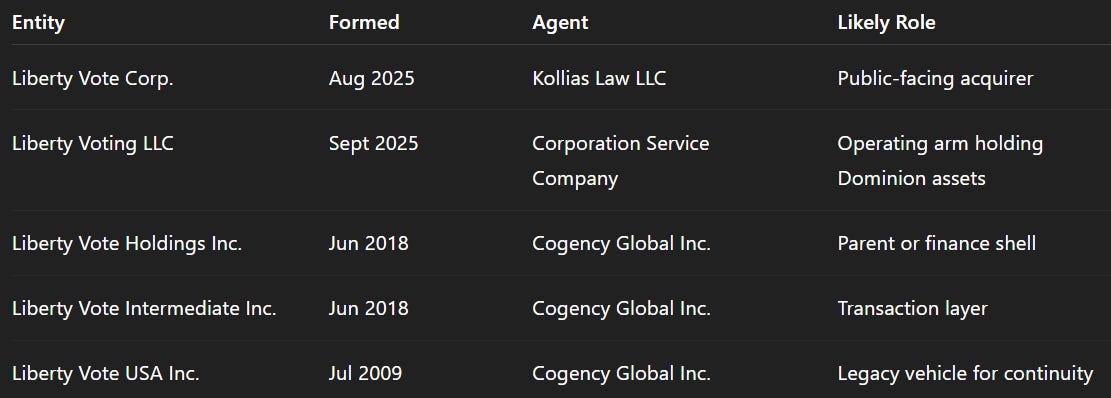
Such layering might be ordinary in commerce, but in election infrastructure it creates unacceptable opacity. Delaware law conceals beneficial owners, so the true financiers of Liberty Vote remain entirely hidden. (The details are guesses in the list above until we find out more.)
No potential investor or political interest can be ruled in or out — and that uncertainty itself is the problem.
The danger cuts both ways: concealed ownership could serve any agenda, from manipulating outcomes to perpetuating distrust by keeping systems opaque enough to blame when results are challenged, or allowing “bugs” and backdoors to persist.
5. Paper Ballots: Worthless if they are not checked.
Liberty Vote’s new branding echoes the Trump administration’s call for “all-paper voting,” implying that paper alone ensures integrity.
In truth, nearly every system already generates a paper trail, and any voting system vendor can process hand-marked paper ballots. The reliance on barcodes or QR codes has never been required, but has been a boon to device manufacturers who can sell many more voter-facing machines when in reality, only a cardboard booth, pen, and paper ballots are needed. Going back to hand-marked paper does not require modifying the “Voluntary Voting System Guidelines” (VVSG) that Trump has demanded in his Executive Order. Any voting system that supports mail voting (and all of them do) can also support fill-in-the-bubble style ballots and avoid bar codes. Done.
But since it actually is quite easy for voting machine makers (and any counties buying them) to convert to hand-marked paper ballots, why change the VVSG standard, which would be at least a multi-year endeavor before any changes exist in the market? It seems the pursuit of changing the standard is another diversion, to be able to complain that the D-party is blocking the progress toward hand-marked paper, when it is actually easy to change BACK to that for any voting system maker. The VVSG standard has many deficiencies, but it needs no changes at all to support hand-marked paper ballots. Election integrity advocates support HAND MARKED PAPER BALLOTS pretty much without exception, regardless of party affiliation.
Plus, Dominion’s (now Liberty Vote’s) ballot-marking devices can produce full-face bubble layouts which CAN support accessibility for voters with disabilities using one accessible machine per polling place, and the ballots are the same format and essentially indistinguishable from a hand-marked ballot.
Yet even if we have hand-marked paper which can be audited, that paper is valuable only when it IS audited. Without verification, even a printed ballot is just another artifact of an unverified process, and they are dutifully stored for 22 months, as required by federal law, but of no use to anyone under seal where no one can see them. Thus, it is essential that we also can require that ballot images are created, saved and published so they can be reviewed.
6. No Trust. We must Verify.
Voting equipment is complex, proprietary, and—like any software—hackable.
Given Liberty Vote’s hidden ownership and its leader’s partisan pedigree, no reasonable observer can assume these systems are immune to manipulation.
The only rational safeguard is transparent, independent auditing: risk-limiting audits, public ballot-image verification, and reconciliation between paper and digital records.
Yet even risk-limiting audits have faltered in practice. As RLA advocate Professor Philip Stark noted at the 2025 DEF CON 33 conference, although RLAs are mathematically sound, the number of states that correctly implement them is “almost exactly zero.” Just as I predicted back in 2019 when I debated Stark at the Election Integrity Conference in Berkeley, CA: Although the mathematics is sound, the implementation is very difficult indeed. Even states that claim to be the “gold standard” only fully audit one or two contests, and those are chosen to be the easy ones, not the ones that really need auditing. In PA, they audited the State Treasurer contest rather than the Trump vs. Harris contest in 2024. WTF indeed.
7. The Bottom Line: Trust Only What Can Be Verified
The Liberty Vote takeover simply reinforces what technologists have long warned: we must assume all election equipment, and even manual procedures, can be compromised.
Security depends on voter-verifiable paper ballots, ideally hand-marked and free of vote-encoding barcodes, combined with comprehensive auditing. Yet even where audits are officially performed, they are often limited in scope and, if insiders are compromised, can be manipulated to ensure that discrepancies are never discovered. Even when election workers act in good faith, they are effectively auditing themselves. As Goodhart’s Law predicts, once the measure becomes the goal, the goal is gamed—workers focus on achieving a “zero-discrepancy” audit report rather than revealing genuine variances. The result: audits that are well-intentioned but ultimately worthless as independent verification.
True accountability requires independent audits, but gaining access to physical ballots is exceptionally difficult. Verification therefore must extend beyond physical recounts to include cryptographically secured ballot-image audits: digital replicas of every voted ballot that are hashed, signed, and publicly published so that any alteration is immediately detectable.
This is the model pursued by AuditEngine, a nonpartisan platform enabling nationwide ballot-image audits. It allows independent review of election results without exposing voter identities and can audit every contest on every ballot, rather than a tiny subset of ballots in sampling audits that that provide only statistical comfort, yet tend to only audit one or two contests, and sometimes the wrong ones.
Until such end-to-end auditing becomes standard, hidden ownership and unverifiable technology will continue to erode public confidence. The Liberty Vote transaction is merely the latest episode in a long pattern of opacity and misplaced trust.
Now, more than ever, we need robust, comprehensive auditing—and citizens actively watching and questioning every step: the voting procedures, the chain of custody, and the audits themselves.
REFERENCES
Ownership & Corporate-Structure / Acquisition
Rubin, Olivia. “Dominion Voting Systems sold to company run by former Republican election official”, ABC News, October 9, 2025. ABC News
“Dominion Voting Systems acquired by St. Louis-based Liberty Vote”, CBS News, October 2025. CBS News
“One Republican Now Controls a Huge Chunk of US Election Infrastructure”, Wired, October 2025. WIRED
“Dominion Voting Systems, previously at the center of false 2020 election fraud allegations, has been sold to a new entity called Liberty Vote”, Politico, October 9, 2025. Politico
“Analyzing Dominion Voting Systems sale to firm run by ex-Republican elections official”, NPR (via The Public Radio), October 11, 2025. TPR
“Dominion Voting Systems, the company at the center of false fraud claims about the 2020 election, has been acquired by an entity called Liberty Vote”, CPR News, October 2025. Colorado Public Radio
Auditing / Risk-Limiting Audits (RLAs)
Lindeman, Mark & Stark, Philip B. “A Gentle Introduction to Risk-Limiting Audits”, IEEE Security & Privacy / NIST, 2012. NIST
Stark, Philip B. “Risk-limiting audits: theory and practice”, presentation at DEF CON Voting Village (slides), 9 August 2024. Department of Statistics
The question was asked: “How many states are doing this?” -- Philip Stark answered, “Yeah, approximately zero”. (laughter) (Offset 52:00 in the DEFCON 33 talk by Stark). He explained further: “Some are doing large portions of this, some are pretending to do it, some have laws that authorize them to do it but aren’t doing it. There’s a lot of variability, yeah.” (I appreciate Stark’s honesty about our situation.) https://media.defcon.org/DEF%20CON%2033/DEF%20CON%2033%20villages%20and%20creators/DEF%20CON%2033%20-%20Voting%20Village%20-%20Stark%20-%20Risk%20Limiting%20Audits.mp4“Election Auditing: Best Practices and New Areas for …”, MIT Election Lab Report, October 2023. Link MIT Election Lab
“Risk-Limiting Audit – Final Report”, U.S. Election Assistance Commission (EAC), 2015. Link U.S. Election Assistance Commission
Additional Sources / Context
“Colorado county clerks question company taking over Dominion Voting Machines”, 9News (Denver), October 2025. 9News
“Dominion sale not expected to change Colorado elections, experts say”, Colorado Newsline, October 16 2025. Colorado Newsline
More by Ray Lutz
Prior Post: https://open.substack.com/pub/raylutz/p/taming-our-elections-you-can-help “Taming our Elections, you can help! -- Eyes Open: Join the Movement for Election Transparency”
Next Post:
All Posts: https://substack.com/@raylutz/posts
I think any state using dominion products should switch to a different branded machine, or provide taxpayers with an electronic voting ability (e.g., digital, online?) that is secure and hack-proof.
Voting needs to be partisan. Maybe hand count?